+EV Scanner Panel
The +EV Scanner helps you find bets where the odds are in your favor—situations where, over time, you'll profit by consistently taking these positions. Unlike arbitrage, which guarantees profit on every individual bet, positive expected value (+EV) betting is a long-term strategy where your edge compounds across hundreds of bets.
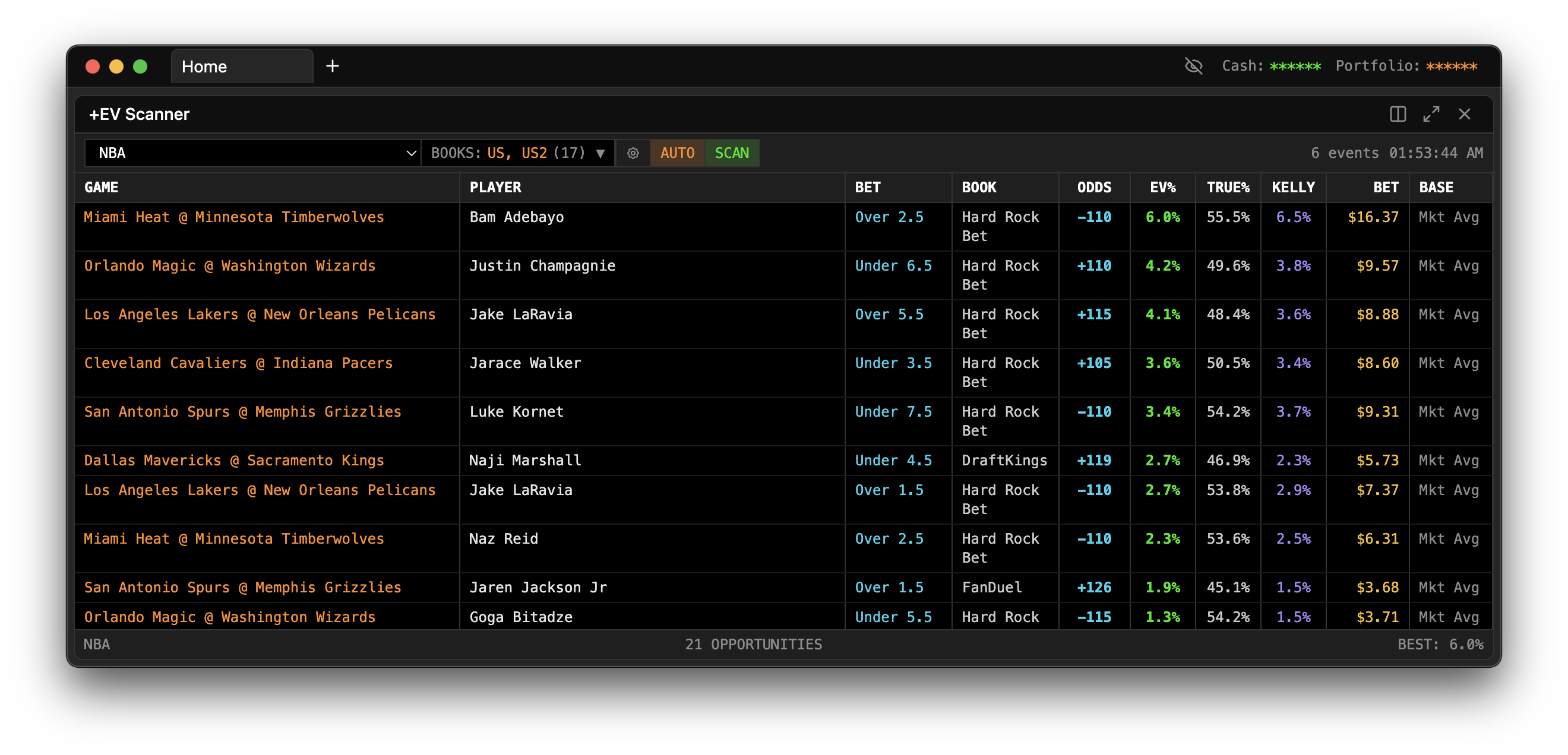
Opening the Panel
Press / to open the Command Palette, type PEV, and press Enter. The scanner will load and begin searching for +EV opportunities.
What Is Expected Value?
Expected value (EV) is a mathematical concept that captures the average outcome of a bet if you could place it infinite times. A positive expected value (+EV) bet is one where the math is in your favor—the odds being offered are better than they should be based on the true probability of the outcome.
Consider a coin flip. The true probability of heads is 50%. A fair bet would pay even money (1:1). But imagine a sportsbook offers +110 on heads—meaning you win $110 for every $100 risked. That's a +EV bet. The outcome is still random (you might lose this flip), but if you could take that bet thousands of times, you'd come out ahead.
The challenge is knowing the "true probability" of real-world events. Unlike a coin flip, we don't know the exact probability that the Lakers win tonight. The +EV Scanner addresses this by comparing a sportsbook's odds against a baseline—typically derived from sharp betting markets or consensus across multiple books—to estimate where true value lies.
How the Scanner Finds +EV
The scanner constantly compares odds across sportsbooks to a "true probability" baseline. This baseline might come from a respected sharp book (a sportsbook known for having efficient, accurate lines) or from a mathematical model that synthesizes information from multiple sources.
When a sportsbook offers odds that are significantly better than what the baseline suggests, that's a potential +EV opportunity. The scanner calculates the expected value, expresses it as a percentage, and presents it to you.
For example, if the baseline suggests a team has a 40% chance to win, the fair odds would be around +150. If a sportsbook offers +180, you're getting a better price than the market says is fair. That's positive EV.
Configuring the Scanner
To get personalized recommendations, configure the scanner with your parameters.
Bankroll
Enter your total betting bankroll—the money you've dedicated to betting. This figure is used to calculate recommended bet sizes using the Kelly criterion. Be honest here; overstating your bankroll leads to oversized bets and excessive risk.
Kelly Fraction
The Kelly criterion is a formula that determines optimal bet sizing based on your edge and the odds offered. Full Kelly maximizes long-term growth but can be volatile—you might experience significant swings.
Most bettors use a fraction of Kelly to smooth out the ride:
Full Kelly (1.0) maximizes theoretical growth but involves aggressive bet sizing. Your bankroll will swing dramatically, and a few losses can hurt significantly. Only for those with strong stomachs and high confidence in their edge.
Half Kelly (0.5) is a popular choice. You sacrifice some long-term growth for significantly reduced volatility. Many professional bettors settle around this level as a balance between growth and risk management.
Quarter Kelly (0.25) is conservative. Your bet sizes are small relative to your edge, which means slower growth but much smoother results. Good for those just starting out or those who aren't fully confident in the scanner's baseline accuracy.
Minimum EV Threshold
This setting filters out opportunities below a certain expected value percentage. Setting a 2% minimum means you'll only see bets where you have at least a 2% mathematical edge.
Higher thresholds mean fewer opportunities but more confidence in each one. Lower thresholds show more bets but include marginal situations where the edge might not overcome transaction costs or model uncertainty.
Bookmaker Selection
Choose which sportsbooks to include. The scanner will look for +EV opportunities at these books. Include all books where you have accounts and can actually place bets.
Understanding the Results
Each row in the results represents a +EV opportunity. Here's what each column tells you.
Event identifies the game or match where the opportunity exists. You'll see the teams or players involved and the sport.
Market specifies what type of bet this is—moneyline, spread, total, or a specific prop. This tells you exactly what you'd be betting on.
True Probability is the scanner's estimate of the actual likelihood of this outcome occurring. This comes from the baseline—a sharp book or model that the scanner trusts as accurate.
Book Odds shows what the sportsbook is offering. This is the actual price you'd get if you placed the bet.
EV% is the expected value expressed as a percentage. A +3% EV means that, on average, you'd profit $3 for every $100 wagered on this bet. Higher is better, but remember: individual bets still win or lose randomly.
Kelly shows what percentage of your bankroll the Kelly criterion suggests betting. This is before applying your Kelly fraction. If full Kelly says 5% and you're using half Kelly, your actual bet would be 2.5% of bankroll.
Bet Size translates Kelly into dollars based on your entered bankroll. This is the recommended wager amount if you want to follow optimal bet sizing.
Placing +EV Bets
When you find an opportunity, navigate to the sportsbook and verify the odds are still available. Lines move quickly, especially around game time. If the odds have shifted, the bet may no longer be +EV—or the edge may be smaller than originally calculated.
Place the recommended bet size, or adjust based on your comfort level. Some bettors use even smaller sizes than Kelly suggests until they're confident the system works for them.
Track your bets. Record the expected value at the time of bet placement and your actual results. Over time, this data helps you understand whether you're realizing the expected edge.
The Long Game
+EV betting is fundamentally different from arbitrage. With arbitrage, every bet profits. With +EV, individual bets absolutely can and will lose. You might lose five +EV bets in a row. This is normal variance, not evidence that the strategy isn't working.
The edge reveals itself over large sample sizes. A 3% edge doesn't mean you win every time—it means over thousands of bets, you'll profit about 3% of your total wagered. In the short run, anything can happen. Losing streaks will test your discipline.
This is why bankroll management matters so much. The Kelly criterion helps ensure you never bet so much that a losing streak wipes you out before the math can work in your favor. Patience and consistency are the keys to +EV success.
Variance and Sample Size
Expect results to fluctuate wildly in the short term. A bettor with 1,000 +EV bets might see their actual return range anywhere from significant profit to breakeven to temporary loss, even if their average edge was genuinely positive.
As sample size increases, results converge toward expected value. A bettor with 10,000 bets under their belt has a much clearer picture of their true edge. This is why serious +EV bettors think in terms of years, not days or weeks.
If you're just starting out, don't overreact to short-term results. Give the strategy time to prove itself, and keep your bet sizes conservative until you've verified the scanner's accuracy with real-world results.
Trusting the Baseline
The scanner is only as good as its baseline. If the "true probability" estimate is wrong, the expected value calculations will be off. No baseline is perfect.
Be aware that even sharp books and models have limitations. They may be slow to react to late-breaking news, or they might have biases in certain markets. Treat the scanner's output as a tool to help you find opportunities, not as infallible truth.
Over time, you might develop your own sense of which markets the scanner is most accurate for and which it struggles with. Use your judgment alongside the scanner's recommendations.
Troubleshooting
If no opportunities appear, try lowering your minimum EV threshold. Opportunities above 5% are rare in efficient markets. Also check that you've selected enough bookmakers—the scanner needs variety to find edges.
If recommended bet sizes seem aggressive, reduce your Kelly fraction. There's no shame in using quarter Kelly or even smaller while you build confidence.
If your results don't match expectations over a large sample, the baseline may have inaccuracies in certain markets. Consider focusing on sports or bet types where the scanner has historically been most accurate.